
Listen to this article in summarized format
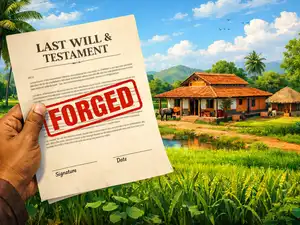
On January 15, 2026, the Delhi High Court stated that during the probate proceedings of a Will, its authenticity must be evaluated based on Section 68 of the Indian Succession Act, following Section 65 of the Indian Evidence Act. Even if the signatures appear to be genuine, the Will may still be deemed invalid.
Income Tax Guide
Income Tax Union Budget FY 2026-27 LiveIncome Tax Slabs FY 2025-26Income Tax Calculator 2025
The court also pointed out that accusations of forgery and presenting a forged document as authentic, are separate offences under the Penal Code.If proven, these allegations carry legal repercussions that are independent of the probate case’s outcome.
In this particular case, a son informed the Delhi High Court case that he had inherited a property in Paschim Vihar, Delhi from his father. However, during the probate proceedings of his father’s Will, his late grandmother and aunt failed to mention this property. The son also claimed that his father had applied for mutation and conversion of this property to freehold before the DDA, but his uncle is opposing it on false grounds and is currently occupying the property illegally.
Conversely, the aunt told the court that while his father was alive, he executed a Will on April 29, 2011, which was registered on May 4, 2011 in the office of the Sub-Registrar VII, LM Bundh Office Complex, Shastri Nagar, Delhi. There was a witness present for this Will.
The son alleged that the Will produced by his late grandmother and aunt does not bear his father’s authentic signature or thumb impression. He argued that the forgery is clear since the photograph affixed on the alleged Will, is from around May 2004, while the Will is said to have been executed and registered on April 29, 2011.
On January 15, 2026, the son succeeded in his case to continue the police criminal investigation into the Will forgery. While his aunt failed to stop the FIR, the Will’s validity is still undecided.
What does this ruling say about parallel proceedings for Will forgery case and probate of Will case?
Kalpit Khandelwal, Partner, Aekom Legal said to ET Wealth Online that both the proceedings (Will forgery and probate of Will) can continue simultaneously.
A probate court decides the validity for succession based on preponderance of probabilities (a civil standard). A criminal court examines forgery based on the stricter test of beyond reasonable doubt.
Khandelwal says: “It is possible that probate is granted first, and later a criminal court finds the will forged. In such cases, an application under Section 263 of the Indian Succession Act can be filed to revoke probate for “just cause.”
Sachin Bhandawat, Partner at Khaitan & Co says that while this simultaneous proceedings aspect may be correct, it is an unlikely event.
A probate proceeding as a civil case has a lower burden of proof and requires the Plaintiff to prove the inauthenticity of the Will, whereas a criminal case has a higher burden of proof that requires criminal intent to be demonstrated, but with the State’s full forensic and investigative abilities at play.
Bhandawat says: “What this means is that although a criminal case may continue for forgery even though the probate is granted – one case is likely to have a bearing on the other.”
Bhandawat further says, “if probate is granted but then the criminal court finds the Will to be forged, the affected party may be justified in applying for revocation of probate.”
Also readUnchallenged will enough for land mutation, says Supreme Court; sale agreement holder loses claim
What precautions should readers take to avoid allegations of forgery in a Will?
According to Khandelwal, a Will should be clearly drafted, signed by the testator, and attested by two independent witnesses as required by law. Registration, though not mandatory, adds credibility.
Khandelwal says: “Use recent photographs and ID proof, avoid alterations, and maintain medical records confirming sound mental capacity. Informing close family members and safely preserving the original document can also help minimise suspicion and litigation.”
Is there any time limit for applying for such revocation of Will after Probate is granted?
Khandelwal says that an application for revocation of probate of Will under Section 263 of the Indian Succession Act is generally treated as subject to limitation.
Khandelwal says: “While the Succession Act itself does not prescribe a specific time limit, courts have held that such an application will be governed by Article 137 of the Limitation Act, which provides a three-year limitation period from the date when the right to apply accrues.”
Also read: Think twice before picking a Will writer: How close relationships can complicate probate
According to Khandelwal, the clock for calculating the limitation period would start from the date the applicant first becomes aware of the “just cause” for revocation, and not necessarily from the date probate of Will was granted.
 aniltikotekar4sme.com