Between 2019 and 2025, FM Nirmala Sitharaman quietly rewired India’s income tax system through a series of calibrated reforms rather than one sweeping overhaul. Across six Union Budgets, the government moved away from a deductions-heavy, compliance-intensive old tax framework toward lower rates, simpler slabs and minimal human interface.
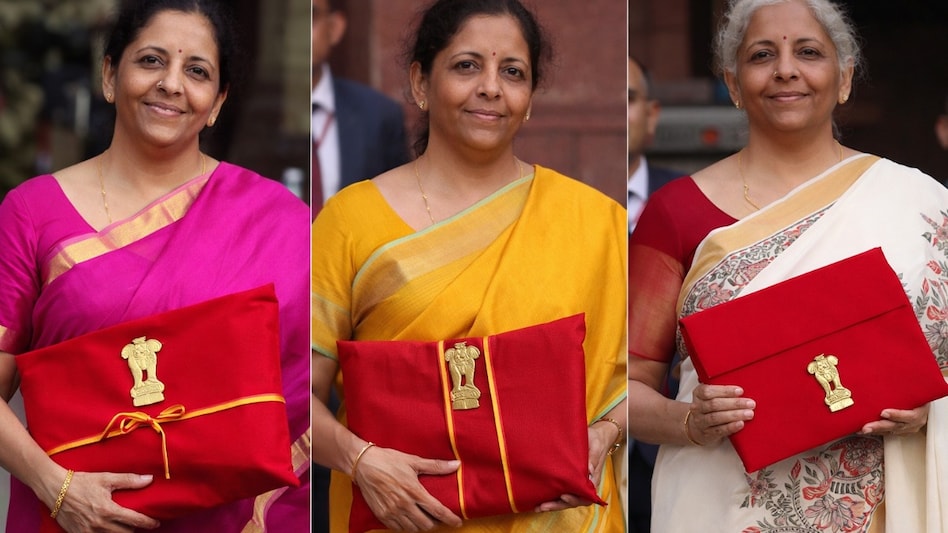 With Budget 2026, Finance Minister Nirmala Sitharaman is set to create history by becoming the first finance minister to present nine consecutive Union Budgets.
Budget 2026: Between 2019 and 2025, Union Finance Minister Nirmala Sitharaman has overseen the most far-reaching overhaul of India’s income tax framework since liberalisation. Across six Union Budgets, the government steadily dismantled a deductions-heavy, compliance-intensive system and replaced it with a lower-rate, simplified regime—culminating in a landmark move to make income up to Rs 12 lakh tax-free.
Rather than delivering one dramatic reform, Sitharaman’s approach unfolded in phases, combining rate cuts, administrative restructuring and a fundamental rewrite of tax law.
Budget 2019
FM Sitharaman’s first Budget in July 2019 focused on targeted personal tax relief without disturbing slabs. The government announced an additional deduction of Rs 1.5 lakh on interest paid for affordable home loans sanctioned till March 31, 2020. For eligible buyers, total interest deduction rose to ₹3.5 lakh, offering meaningful savings over the life of a loan.
The real inflection point came two months later. In September 2019, the government slashed the corporate tax rate for domestic companies from 30% to 22%. New manufacturing companies incorporated after October 1, 2019, were offered a concessional 15% rate. This reform sharply improved India’s investment attractiveness and signalled a decisive shift towards growth-led tax policy.
Budget 2020
Budget 2020 introduced the optional new personal income tax regime—arguably the most consequential reform of Sitharaman’s tenure. Taxpayers could opt for lower slab rates if they gave up most exemptions and deductions such as HRA, LTA and Section 80C benefits.
New Tax Regime Slabs (Introduced in Budget 2020)
Income Slab (₹) Tax Rate
Up to 2.5 lakh Nil
2.5 – 5 lakh 5%
5 – 7.5 lakh 10%
7.5 – 10 lakh 15%
10 – 12.5 lakh 20%
12.5 – 15 lakh 25%
Above 15 lakh 30%
Initially, adoption was muted, as salaried taxpayers remained attached to deductions. However, the regime laid the groundwork for a long-term restructuring of personal taxation.
Budgets 2020–2021
Parallel to rate reforms, the government transformed tax administration. The faceless assessment and faceless appeal systems eliminated physical interaction between taxpayers and officials. Cases were allocated electronically, hearings were conducted online, and orders were centrally reviewed.
This structural shift aimed to curb discretion, reduce harassment and improve trust—marking a move away from officer-driven assessments to system-driven compliance.
Budget 2023
Budget 2023 marked a turning point. The new tax regime was made the default option for individuals, though taxpayers could still opt for the old regime.
Crucially, the Section 87A rebate was enhanced, effectively making income up to Rs 7 lakh tax-free under the new regime (Rs 7.5 lakh for salaried individuals after standard deduction). The government also cut the highest surcharge rate from 37% to 25%, reducing effective tax rates for high earners and simplifying India’s complex surcharge structure.
Budget 2024
The Union Budget 2024, presented on July 23, 2024, introduced a series of measures aimed at simplifying and rationalising the tax system, easing compliance, providing relief to taxpayers and creating a more favourable environment for foreign investors. Key proposals included a comprehensive review of the Income-tax Act, 1961, to make it more concise, simplification of foreign direct investment and overseas investment rules, and a review of stamp duty rates across states.
For foreign investors, a major step was the abolition of the equalisation levy on non-resident e-commerce operators from August 1, 2024. The Budget also proposed reducing the corporate tax rate for non-residents from 40% to 35% from FY 2024–25, while leaving domestic corporate tax rates unchanged. Safe harbour rules were expanded and transfer pricing procedures streamlined to reduce litigation.
The capital gains regime was simplified by standardising holding periods and introducing uniform rates, with long-term capital gains taxed at 12.5% and short-term gains on listed securities at 20%. Individual tax slabs under the new regime were revised and the standard deduction increased to ₹75,000. The Budget also proposed changes to buyback taxation, rationalised TDS provisions, raised securities transaction tax on derivatives, increased employer pension contribution deductions, and introduced the Direct Tax Vivad se Vishwas Scheme, 2024, to settle long-pending disputes.
Budget 2025
Budget 2025 delivered the most sweeping personal tax relief yet. Income up to ₹12 lakh was made entirely tax-free under the new regime, rising to ₹12.75 lakh for salaried taxpayers after the enhanced standard deduction. Slabs were restructured to delay entry into higher tax brackets, easing pressure on middle-income earners.
New Tax Regime Slabs (Effective FY 2025–26)
Income Slab (₹) Tax Rate
Up to 4 lakh Nil
4 – 8 lakh 5%
8 – 12 lakh 10%
12 – 16 lakh 15%
16 – 20 lakh 20%
20 – 24 lakh 25%
Above 24 lakh 30%
Alongside rate changes, Sitharaman unveiled the new Income-tax Act, 2025, replacing the 1961 law. The rewritten legislation seeks to simplify language, remove ambiguities and reduce litigation. It is expected to come into force from April 1, 2026.
Tax regime reboot
Taken together, the income tax changes between 2019 and 2025 reflect a clear policy arc:
> Lower headline tax rates
> Fewer exemptions and deductions
> Minimal human interface
> Greater certainty and compliance
Official data now shows that fewer than 20% of taxpayers remain in the old tax regime, underscoring the government’s success in nudging India towards a simpler, lower-rate tax system.
Budget 2026–27
After delivering sizeable income tax relief in the previous Budget and with recent GST cuts already lowering the cost of living, the government is not expected to announce fresh reductions in personal income tax slabs this year. Policymakers appear inclined to pause and consolidate gains rather than reopen the rate structure so soon.
That said, industry body PHDCCI has pitched for further rationalisation of personal tax rates. It has proposed a simplified structure with a 20% rate for income up to Rs 30 lakh, 25% for income between Rs 30 lakh and Rs 50 lakh, and 30% for earnings above Rs 50 lakh, arguing that a flatter slab design would ease the burden on the middle class and improve long-term tax compliance.
 aniltikotekar4sme.com