Clipped from: https://indianexpress.com/article/opinion/columns/p-chidambaram-writes-fasten-your-seat-belt-9650431/
Inflation is not yet on the path toward the target rate of 4 per cent. Food and fuel prices complicate matters. Both do not respond to interest rate changes…The governor argued that there was justification for keeping the repo rate unchanged.
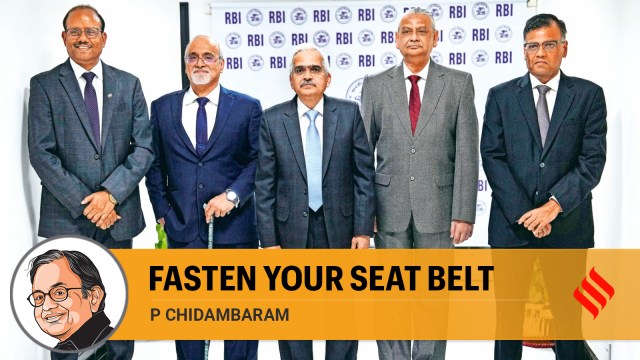 Reserve Bank of India (RBI) Governor Shaktikanta Das with Deputy Governors Michael Debabrata Patra, M. Rajeshwar Rao, Swaminathan Janakiraman and T Rabi Shankar arrives to address a press conference on monetary policy statement, at the RBI headquarters in Mumbai. PTI/FILE
The Monetary Policy Statement of the RBI grabs the headlines for one reason: the policy repo rate. Repo rate is the interest rate at which the central bank (RBI) will lend money to commercial banks in exchange for securities with a promise to re-purchase the securities at a later date. Borrowers are happy if the repo rate is decreased because it means that banks can borrow at a lower rate and, consequently, can lend at a lower rate. Inflation watchers are happy if the repo rate is increased because the rate is believed to be the instrument to control inflation. If the repo rate is unchanged, it will keep all stakeholders guessing.
The repo rate was reduced from 5.0 per cent to 4.0 per cent on March 27, 2020. It was a big cut, and was justified on the ground that a Covid-hit economy faced the danger of a recession. It remained at 4.0 per cent for 26 months. When Covid waned and the economy showed signs of revival, in May 2022, the repo rate was sharply hiked to 4.40 per cent — ostensibly to tame inflationary expectations. It steadily climbed to 6.50 per cent by February 2023, where it has remained for 20 months. Since May 2022, Mr Shaktikanta Das, the governor, has been an inflation-warrior but the unchanged repo rate means that RBI has not yet succeeded in taming inflation.
No governor can please all the stakeholders. The UPA government constituted a monetary policy committee (MPC) to share the burden of the governor, but the final decision is still the governor’s. The governor has to balance growth and inflation, and take a decision.
Advertisement
Inflation is not yet on the path toward the target rate of 4 per cent. Food and Fuel prices complicate matters. Both do not respond to interest rate changes. In September 2024, the year-on-year price increases were for tomato (42.4 per cent), for onion (66.2) and for potato (65.3). The governor argued that there was justification for keeping the repo rate unchanged. The contrary argument is that a high repo rate has the effect of dampening the growth rate of the economy.
Growth & Inflation
Growth and inflation are the two primary concerns of the RBI as well as the government. Mr Shaktikanta Das cheered the projected growth rate of 7.5 per cent in the current year but also flagged inflation that is expected to be 4.5 per cent. Inflation has not yet reached that level; the inflation rate in September 2024 was higher at 5.49 per cent. The all-India Consumer Food Price Index stood at 9.24 per cent.
The RBI’s Monetary Policy Report issued in October 2024 has more to say on the two subjects. On the ‘Outlook for Growth’, after reciting the government statistics, the Report said, “Uncertain global economic outlook, lingering geopolitical conflicts, rising supply chain pressures, and volatile global financial conditions, however, weigh heavily on the outlook to the downside.” The Report also flagged other factors such as “geoeconomic fragmentation, deceleration in global demand, and frequent weather-related disturbances due to climate change.” On the ‘Outlook for Inflation’, the Report identified the risks as “rising global supply pressures, adverse weather events, uneven distribution of rainfall, prolonged geopolitical conflicts and resultant supply chain disruptions, uptick in food and metal prices, volatility of crude oil prices, and adverse weather events.” They add up to 10 separate downside risks.
The Headwinds
The Monthly Economic Review of the Ministry of Finance has a candid assessment. It described the performance of the Indian economy as “satisfactory” but cautioned that “Underlying demand conditions bear watching. Further, risks to growth arise from escalating geopolitical conflicts, deepening economic fragmentation and elevated valuations in financial markets in some advanced economies.”
Advertisement
The NCAER’s monthly economic review is balanced. After highlighting the bright spots, the Review pointed out the downsides: moderation in bank credit; deceleration on personal loans, services, agriculture and industry; depreciation of the rupee; and decrease in FPI inflows.
In my view, the bird’s eye view is very different from the worm’s eye view. While the former is important to have a view of the macro-economy, it is the latter that reflects the gains and pains of the common people. The people’s concerns are unemployment, high inflation, stagnant wages, growing inequality between the rich and the poor, over regulation, GST and harsh GST administration, poor quality of education, unaffordable medical services, uncaring bureaucracy, and public expenditure that favours the rich and squeezes out the poor.

Inform your opinion. Read what today’s changemakers are saying. Subscribe to our Opinion & Editorial newsletter
Along with the above, several other things could go wrong: the brutal war in the Middle-East could drag in more countries. The Russia-Ukraine war could involve the NATO countries. Manipur could see another conflagration. Maharashtra elections could throw up a surprise. China-Taiwan or South Korea-North Korea could become a hotspot. Mr Donald Trump could be elected President. So, please fasten your seatbelt, there is turbulence ahead.
 aniltikotekar4sme.com