Mint Road has pulled the plug on clever financial arrangements between regulated entities and fintechs, with stress on skin in the game

V Raman Kumar, founder and chairman of CASHe, a digital credit platform for millennials, never tires of reminding anyone who cares to listen that his firm never got the valuations that fintechs typically command, because he was not clever enough. “But being clever can’t be a business model.” It’s like chugging along on someone else’s rails for an easy ride.
Last week, the Reserve Bank of India (RBI) drove home this point when it said that first-loss default guarantees (FLDGs) — financial buffers offered by unregulated fintechs to regulated entities (REs) against defaults on loans originated by the former — are to be capped at five per cent of such exposures. This is expected to arrest the tendency of REs going soft when underwriting credit, taking comfort from the FLDGs.
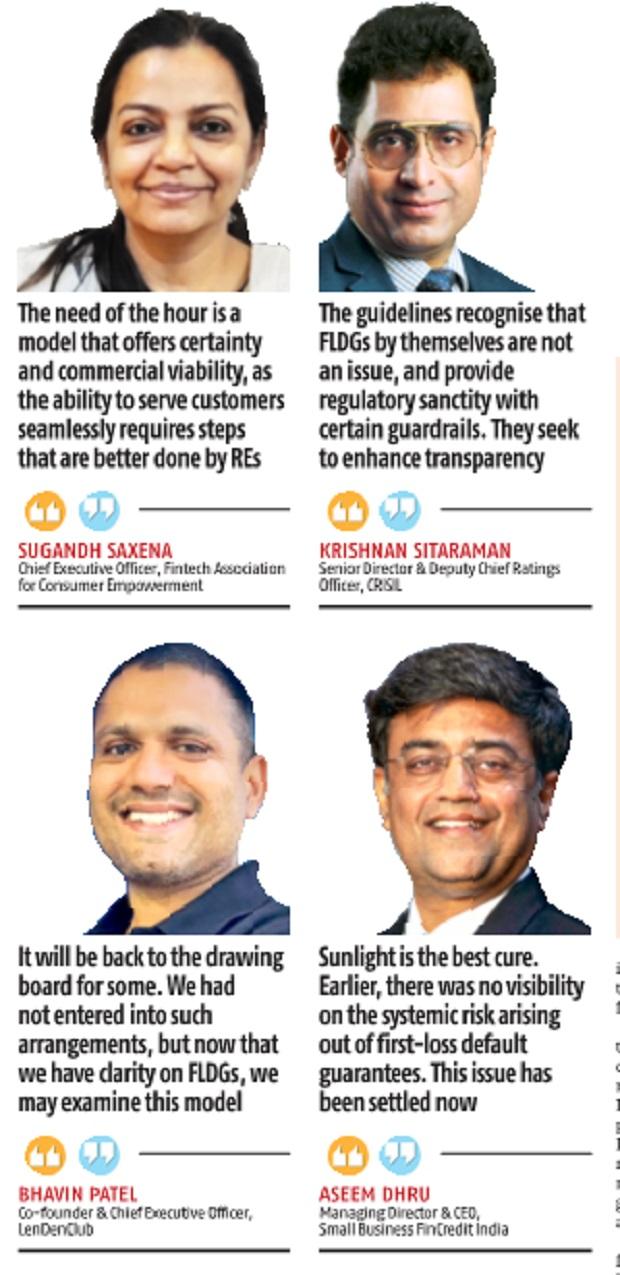
In some cases, these were as high 75 per cent of the loans originated. “Sunlight is the best cure. There was no visibility on the systemic risk arising out of FLDGs. This issue has been settled now,” says Aseem Dhru, managing director and chief executive officer (CEO) of Small Business FinCredit India.
While Mint Road’s hygiene step will bring more clarity to FLDG arrangements, it might act as a dampener for lending to the new-to-credit (NTC) segment that has no credit histories, and which has grown hugely in recent times.
A study by TransUnion, a Chicago-based consumer credit reporting agency, found that 31 million Indian consumers debuted with credit products through the first nine months of 2022, on the back of 35 million in 2021. Millennials (those born between 1980 and 1994) accounted for 42 per cent of fresh credit; and Gen Z (born between 1997 and 2012, according to the Pew Research Centre, and the US Census of 2022) came in next at 29 per cent.
According to Bhavin Patel, co-founder and CEO of LenDenClub, a peer-to-peer lender, “it will be back to the drawing board for some. In our case, we have not entered into any such arrangements, as we were sure the RBI would look into it. Now that we have clarity, we may examine this model”.
On the flip side, the FLDG cap at 5 per cent may make it unattractive for REs (mainly shadow banks) to take on NTC risks. And there is speculation that pricing on offerings to this segment (especially, on unsecured credit) will move higher, to compensate for the lower FLDG buffer.
Itputs the financial inclusion aspect in the spotlight.
The clever ones and FLDGs
The RBI over the past year and a half sought details of FLDG exposures of select banks and non-banking financial companies (NBFCs), even as it informally conveyed its discomfiture over such exposures. The Report of the Working Group on Digital Lending including Lending through Online Platforms and Mobile Apps, released on November 18, 2021— unusually for such reports — fleshed out this relatively little-known structuring.
FLDGs are synthetic structures that enable unregulated entities to lend without complying with prudential norms through credit-risk sharing arrangements. REs appoint lending service providers (LSPs) as agents that provide all manner of services — customer acquisition, underwriting and pricing support, disbursement, servicing, monitoring, collection, liquidation of specific loans or loan portfolios for compensation.
The working group’s stance was that REs must have the ability to handle these functions and exercise responsibility for them, even when LSPs are engaged. For all practical purposes, credit risks were borne by LSPs without having to maintain any regulatory capital. “Rent-an-NBFC model by digital lenders”, the working group observed (though this involved a few banks as well).
That it was a free-for-all is evident from the RBI making it clear that henceforth there would have to be explicit, legally enforceable contracts between REs and FLDG issuers. FLDGs issued to REs have to be backed by cash, fixed deposits in banks, or bank guarantees executed in their favour. This may well result in additional fund-raising by fintechs.
In the immediate future, all existing FLDG partnerships may require reworking. This will do away with another bug-bear. “The uncontrolled loan growth of Chinese apps offering very high FLDGs will taper down, as high FLDGs ultimately lead to high interest costs for customers,” says Anand Kumar Bajaj, CEO of Nearby Technologies, a fintech firm. This happens because REs were pricing at usurious rates, basking in the comfort of FLDGs in the event of defaults. “Since REs have access to all data and credit bureaus, they can do appropriate credit evaluation with the help of LSPs and partners who help originate loans with a five per cent FLDG,” he adds.
“The guidelines recognise the fact that FLDGs by themselves are not an issue and provide regulatory sanctity with certain guardrails. They attempt to enhance the transparency in usage and disclosure requirements,” notes Krishnan Sitaraman, senior director and deputy chief ratings officer at CRISIL Ratings. That said, a few players will have to go back to the drawing board in cases where existing FLDGs are above the permissible limit. “In certain cases, to offset the impact of higher FLDGs, the interest rate sought by REs from sourcing entities (fintechs) could go up,” he adds.
It is hard to pinpoint exactly when such arrangements came into being. One theory is that banks and a few NBFCs went into retail lending (when corporate loans came under stress) and tapped into the new-to-credit segment with little by way of credit histories. This got a boost when the RBI in September 2019 reduced the risk-weights for consumer loans by 25 basis points to 100 per cent at a time when the economy was slowing down. Moody’s had warned at the time that “the reduction in risk weights would encourage banks to increase their exposure to this loan segment at a time when credit risks are already increasing from a slowing economy.”
The rush to get NBFC licences may also pick up, since Mint Road has made it clear that FLDG issuers have to be REs even if they are only to originate business. Sugandh Saxena, CEO of the Fintech Association for Consumer Empowerment, is of the view that since many fintechs have been around for a few years and know their business and customer segment well, “the need of the hour is a kosher model that gives certainty and commercial viability, as the ability to serve customers seamlessly from onboarding to closure requires steps that are better handled by REs”. And working within the regulatory framework generates greater trust from regulators, customers and other stakeholders.
Back to the drawing board
All existing FLDG arrangements will have to be reworked
The new-to-credit segment may suffer in the immediate future
Pricing on loans may move higher, to compensate for the FLDG cap of 5 per cent of the book
The rush on the part of fintech originators to get NBFC licences may gain pace
This is the end of the road for lending apps offering high FLDGs, especially Chinese ones
Fresh alliances between fintechs and legacy regulated entities are in the offing.
 aniltikotekar4sme.com